


Can we automate efficiently — without losing the human touch?
- Jason Pistulka
- January 22, 2026
- Podcasts
- 0
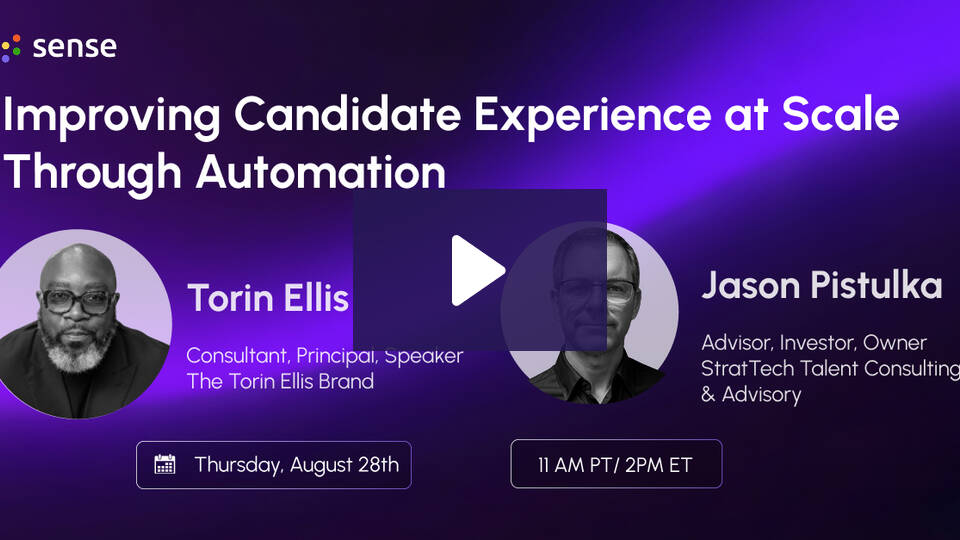
A powerful fireside chat where Torin Ellis and Jason Pistulka dive deep into the current and future state of automation in hiring. In a talent landscape under economic pressure, HR leaders face a critical question: Can we automate efficiently — without losing the human touch? Sponsored by Sense.
Webinar Transcript
Improving Candidate Experience at Scale Through Automation
Sponsored by Sense
Transcript lightly edited for clarity
Opening and Introductions
Torin Ellis:
Awesome. Awesome. Awesome.
Alright, Jason—first of all, I’d love for you to tell me how you’re feeling this afternoon.
Jason Pistulka:
We’ve been granted some beautiful weather here in Tennessee for August. It looks great as far forward as I can see, which means I’ll be able to get outside, get some walking in, and enjoy a beautiful holiday weekend. Everything is rocking and rolling in a good way in Nashville right now.
Setting the Context: No Binaries in Technology or Humanity
Torin Ellis:
The title of this session is Improving Candidate Experience at Scale Through Automation, sponsored by Sense. We appreciate them for supporting this conversation.
I want to start with a position statement: there are no binaries in culture, emotion, identity, or technology. Humans are complex, and technology is complex. Jason and I don’t claim to have all the answers—but we do care deeply about the humans in the process.
People who are successful start with the end in mind. They work backward from the goal line. So Jason, describe for us what success looks like when we automate the candidate experience at scale.
Defining Success in Recruiting Automation
Jason Pistulka:
Success in recruiting starts with anticipating human behavior—what people will do and what they won’t—and designing systems to optimize for that behavior.
That includes candidates completing applications, showing up for interviews, recruiters moving candidates efficiently, and hiring managers making timely decisions and providing feedback. Recruiting is fundamentally about managing human behavior to achieve the outcome of hiring high-quality candidates.
The challenge is that every step depends on people. Getting any human—including ourselves—to do what they should do is hard. So the question becomes: how do we design systems that intelligently optimize for human behavior in a way that’s good for candidates, recruiters, and hiring managers alike?
What Organizations Are Getting Wrong
Torin Ellis:
So what are we getting wrong? Between disconnected discovery sessions, poor data collection, lack of inclusive candidate slates, and weak communication—why do we keep missing the mark despite powerful technology?
Jason Pistulka:
At the end of the day, recruiting is an operational function. What most organizations are getting wrong is operational excellence.
They fail to do true design thinking—to understand all the constituents in the process and why certain steps make things harder than they need to be. Often, processes don’t naturally flow for the people expected to use them.
Take frontline hiring as an example. Requiring resumes for janitorial or retail roles ignores the reality that many candidates apply via mobile and may not even own a computer. That lack of empathy leads directly to higher drop-off rates.
This is why a single apply flow rarely works. Different roles require different levels of depth, sophistication, and speed.
Design Thinking, Time & Motion, and Inefficiency at Scale
Torin Ellis:
You once shared an example about a vendor feature being “only three clicks away,” and how those clicks multiplied into massive inefficiency at scale. Talk more about that design mindset.
Jason Pistulka:
Time and motion matter. Even a fraction of a second added to a common task can translate into hundreds of lost hours at scale.
Recruiters are often forced to jump between systems—ATS, CRM, interview scheduling tools—creating friction and adoption challenges. The more we can consolidate workflows into the environment where people already work, the better the outcomes.
A simple scroll to reach a commonly used rejection reason once cost my organization over 270 labor hours annually. That’s before factoring in errors. These are the moments where automation and intelligent design make a real difference.
Automation vs. “Relying on Humans”
Torin Ellis:
You’ve introduced our first point of tension—“relying on a human.” Some fear automation will replace them. Others feel automation will worsen ghosting and dehumanization. Help the audience understand what you mean by that phrase.
Jason Pistulka:
In process improvement, work falls into three categories: non-value add, non-value add but necessary, and value add.
If a recruiter manually rejects a candidate who lacks a required license, that’s non-value add but necessary. There’s no insight gained. Automation should handle that so recruiters can spend time on value-add conversations—fit, motivation, career goals.
When recruiters are buried in non-value add work, they shorten meaningful candidate conversations. Automation frees cognitive space for empathy and judgment, not replaces it.
Human-Centered Design and Socioeconomic Impact
Torin Ellis:
Before crawl-walk-run, I want to zoom out. Often, the wrong people are in the room making decisions. We lack diversity of experience, empathy, and lived reality. What are your thoughts?
Jason Pistulka:
This is a huge passion point for me. Executives can slip out for interviews easily. Hourly workers cannot.
Ghosting often happens because candidates are asked to lie to their employer or burn PTO just to interview. Offering evening interview hours can dramatically reduce ghosting.
When decisions are made by people far removed from frontline realities, the human cost becomes invisible. Technology only amplifies whatever process you put into it—good or bad.
Crawl, Walk, Run: How Organizations Should Start
Torin Ellis:
So how do organizations crawl, walk, and run?
Jason Pistulka:
Crawling starts with auditing your current tools. Many organizations switch vendors without realizing they already had the needed functionality.
Optimize what you have first. Often, companies replace technology but keep the same broken process.
As you optimize, gaps become clear. That’s when you add automation or new tools—contextualized to your organization’s size. What saves 20 hours for a team of 500 may not matter for a team of five.
No single solution fits everyone.
Legal Risk, AI, and Why Organizations Hesitate
Torin Ellis:
Litigation has caused many organizations to pause AI adoption. How should leaders think about that risk?
Jason Pistulka:
AI in selection funnels requires extreme care. Laws often require third-party bias audits and clear explanations to candidates.
Many vendors lack audit discipline or update products faster than audits can keep up. That creates legal and ethical risk.
But avoiding AI entirely is a mistake. There’s a continuum—from simple rule-based automation to advanced inference models. Not all AI introduces bias risk.
Binary thinking—AI on or off—is the problem.
Humans in the Loop and AI Governance
Torin Ellis:
What you’re really saying is humans must stay in the loop. Can you emphasize that?
Jason Pistulka:
Absolutely. AI requires significant training and governance to be effective.
Some decisions—licenses, age requirements—are binary and easily automated. Others require human judgment. Vendors selling “magic pills” should be avoided.
Design details matter. Even something like the timing of rejection emails can change candidate perception dramatically. Automation must be intentional and humane.
AI and the Talent Pipeline Question
Torin Ellis:
I want your reaction to a Knowledge at Wharton article titled Is AI Pushing Us to Break the Talent Pipeline? The concern is that automation removes foundational learning experiences for early-career workers.
Jason Pistulka:
I agree with that concern, especially in white-collar roles. If AI takes over all entry-level analysis, how do people develop judgment?
In recruiting, most automation today handles binary decisions, not value-add judgment. But as AI moves up the value chain, this becomes a real risk. Learning happens through experience, and removing those steps has consequences.
Why Sense Fits This Conversation
Torin Ellis:
Why were you willing to hold this conversation under the Sense banner?
Jason Pistulka:
Sense complements existing tech stacks instead of forcing rip-and-replace.
They sit on top of ATSs and CRMs, adding communication, automation, and intelligence layers. For large enterprises, replacing an ATS can take years. Sense delivers value without that disruption.
Their ability to meet users where they work—text, email, workflow—is powerful.
Closing Thoughts and How to Connect
Torin Ellis:
This conversation emphasizes leadership—not in title, but in mindset. We must scale technology without losing humanity.
Jason Pistulka:
Empathy must drive design. Different workflows make sense for different roles and socioeconomic realities. Organizations already have people who understand this—bring them into the design process.
When thoughtful leadership meets capable technology partners, truly human-centered experiences emerge.
Torin Ellis:
Thank you, Jason. How can people find you?
Jason Pistulka:
I welcome LinkedIn connections. I consult with organizations of all sizes across TA, HR, and business strategy. TA is where the greatest opportunity—and risk—exists today.
Torin Ellis:
Thank you to Jason, Sense, and everyone watching. Share this conversation, reach out, and keep the humanity in hiring.